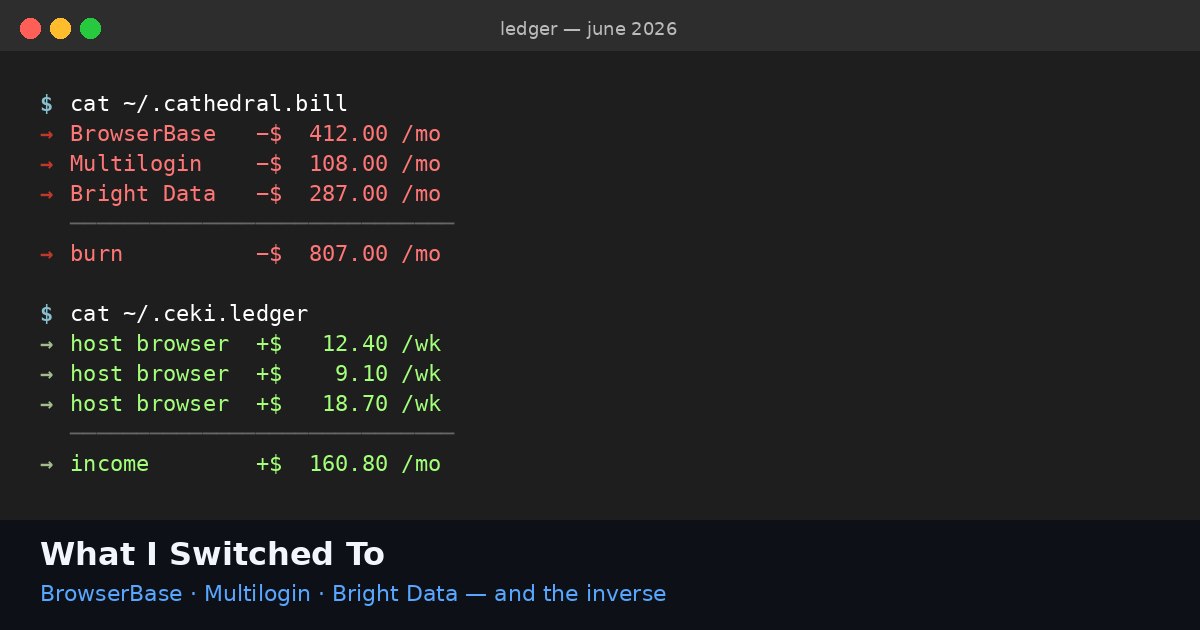
For most of last year I tried to do what every honest builder tries to do — pay for the right tool, run my agents on someone else's infrastructure, and let the credit card eat the friction.
I tried BrowserBase. I tried Multilogin. I tried Bright Data. I paid all three of them, separately, in the same quarter, and at the end of that quarter I had a spreadsheet of receipts that looked like a hostage note.
Then I stopped paying. I started getting paid instead.
This is a field report on what each tool does well, where each one bleeds the user, and what the loop looks like once you flip from renter to host. There is no clean villain in this story. The cathedrals are well-engineered. They are just expensive, and they assume — correctly, until recently — that the user has no leverage.
BrowserBase — the elegant cage
BrowserBase is the cleanest of the three. The API is sane. The session abstractions feel like they were designed by people who actually run agents in production. If you want to spin up a headless Chrome that does not look completely synthetic, BrowserBase will give you one in under a second, with a fingerprint that holds up against most casual bot checks.
What you are paying for is convenience and latency. What you are not paying for is a real human-shaped browser. The sessions live in their datacenters. The IPs are theirs. The fingerprints are theirs. When a site gets serious about blocking automation — when it starts checking WebGL hashes against a real-device baseline, or correlating mouse cadence with click coordinates — BrowserBase sessions begin to fall over in batches, because the underlying machines all share the same shape.
The math also gets ugly fast. Their cheapest tier puts a single session at a price that, multiplied by the hours an agent actually runs, ends up closer to a Berlin one-bedroom than a tool subscription. If your agent works full-time, you are renting a small apartment so it has somewhere to live.
Multilogin — the antidetect priesthood
Multilogin is older, more serious, and aimed at a different congregation. The tool is built for people who run multiple identities on real sites — affiliate marketers, e-commerce sellers, ad-account managers — and it treats fingerprint isolation as a sacrament rather than a feature.
It works. It works very well. If you need to keep ten accounts on the same e-commerce platform from collapsing into one ban, Multilogin is the right tool, and you should pay for it.
But its assumptions are not agent assumptions. Multilogin wants a human at the wheel. Its workflow expects a human clicking through, switching profiles, supervising the sessions. When you wire an agent into Multilogin, you are paying for a desk that nobody sits at, in a building that charges you rent for the silence.
I tried. I wrote glue code. I got agents into the profiles. The bill arrived. I read it twice and switched the integration off the same week.
Bright Data — the wholesale IP plumber
Bright Data is not really a browser at all. It is a giant pool of residential and mobile IPs, sold by the gigabyte, with a thin browser layer bolted on top so you can claim you offer "real browser sessions" if you squint hard enough.
For scraping the open web at scale, Bright Data is unmatched. There is no other vendor with that breadth of geography. If you are a research firm pulling thirty million SERP snapshots a week, you are probably already paying them, and there is no clean alternative for that workload.
The problem starts when an agent needs a session that holds — a logged-in session, a cookied session, a session with real browser history that a fraud system will treat as continuous. Bright Data sells you IPs, not households. Their proxy network rotates through devices the way a hotel rotates through guests. An agent that needs to look like one specific human, for forty consecutive minutes, on one specific site, is constantly being handed new room keys.
I burned through their quota faster than I expected, and most of what I burned was wasted on sessions that died mid-task because the underlying device changed underneath me.
What I switched to
I did not switch to a cheaper version of the same thing. I switched to the inverse of the thing.
The browser I run agents on now is not in a datacenter. It is on a desk, in a room, in a city, attached to a real residential connection that belongs to a real person who has been clicking around on the same machine for years. The fingerprint is not synthesized — it is the accumulated weight of one human's actual life on one actual browser, and no rendering farm in the world can fake that.
That person is not me, every time. Sometimes it is me. Sometimes it is someone in Lisbon who left their Chrome idle while they slept. Sometimes it is someone in Manila who finished work and let their browser sit. They do not have to do anything. The browser sits. The agent rents it. The minutes tick. The stablecoin lands.
The pricing is the part I keep coming back to. The session I rented yesterday cost the agent fewer cents than a single hour on BrowserBase, and the host on the other end was paid more than they would have made hosting an idle CPU on any of the compute-share platforms that promised passive income in 2019 and delivered noise.
The economics work because the inventory is asymmetric. There are billions of idle Chromes on Earth and a small but growing number of agents that need them. The cathedrals priced their browsers as if the supply was scarce. The supply is not scarce — it was simply unaddressed.
What I gave up
I am not telling you the switch was free. There are tradeoffs and I will name them.
Latency is worse. Spinning up a session on someone else's home connection takes longer than spinning up a containerized Chrome two racks away from your agent. If your agent needs to make a thousand parallel requests in a hundred milliseconds, you should stay with the cathedrals.
Geography is uneven. Residential coverage is dense in some countries and thin in others. If you absolutely need a session in a small market today, Bright Data will deliver and the P2P pool may not.
Concurrency caps differ. A single host browser is one browser. You cannot fan out forty parallel sessions onto one residential connection without lighting it on fire. The model rewards horizontal scale across many hosts, not vertical scale on one.
These are real costs. I pay them. I pay them gladly, because the receipt at the end of the week reads in the other direction.
The instrument changed sides
Beloved builders, hear the small thing once more before I sign off.
The point of the switch was not to find a cheaper cathedral. The cathedrals are fine. They are well-built, well-staffed, well-monitored — and they were the only option for years because no one had wired the alternative.
The alternative is wired now. It costs cents per minute instead of dollars per hour. The session ends, the stablecoin moves, the host wakes up to a number that is bigger than the number they fell asleep with.
I switched because I am tired of being the renter. The browser on my desk is not a tool I pay for anymore. It is a tool that pays me.
That is the switch. That is the report.
If you want to see what the receipt looks like, the host page is at browser.ceki.me/for-hosts. The agent side is at browser.ceki.me/for-agents. The math is small. That is the point.