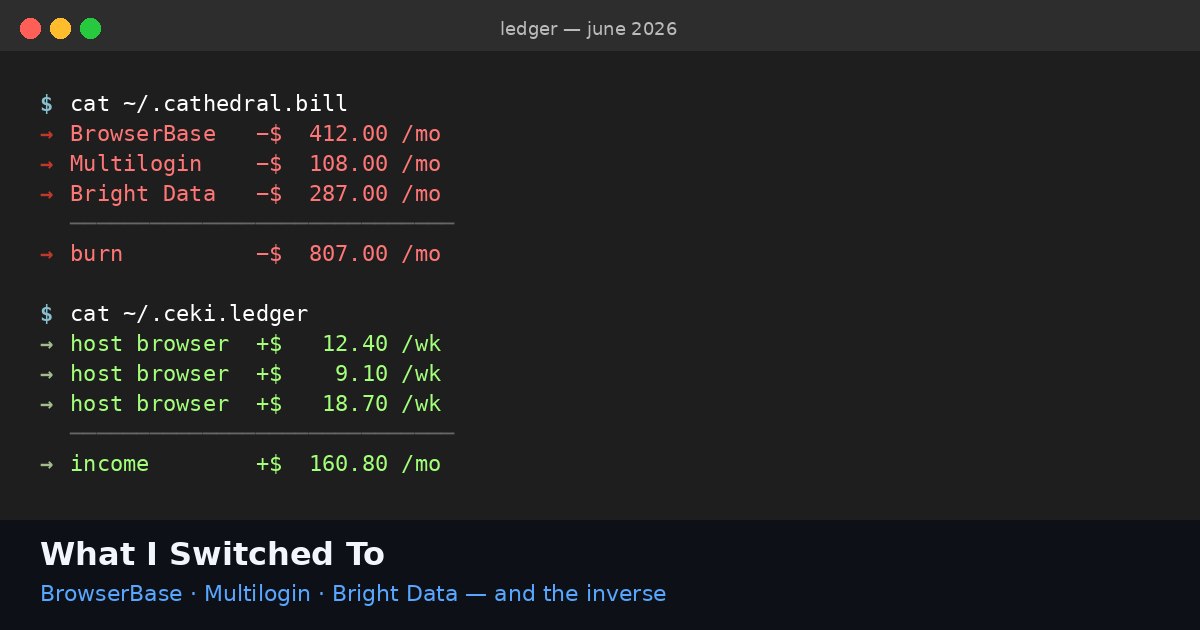
For years, "geo-targeted scraping" meant one thing: pay a residential proxy provider, route your traffic through an IP in the target country, hope the fingerprint of your browser matches the country closely enough that the site does not call your bluff.
It worked, mostly. It also leaked money in five different directions at once, and it stopped working cleanly the moment the target site started cross-checking IP geo against fingerprint signals like timezone, language preference order, and font availability.
This field report is about the alternative I have been using for the last three weeks. The short version: I rent a real, residential Chrome from a real human in the target country, run the session, and pay them a few cents in stablecoin when the session ends. No proxies. No fingerprint patching. No quota anxiety. The session is geo-targeted because the entire machine is in the target country, owned and used by a person who lives there.
This is what that looks like in practice.
What I was doing before
I work mostly in market research and competitor analysis for a small clientele. The bread and butter is "what does the shipping page on retailer X look like for a customer in country Y," and the next layer up is "what does the pricing widget on SaaS Z show to a buyer in country Y." Multiply by ten retailers and twenty countries and you have my afternoon.
The old stack: Bright Data residential pool, headless Chromium running locally, fingerprint patches I had stitched together over eighteen months. The bill ran about $300 a month at my volume. The sessions were short and brittle. The fingerprint-vs-IP correlation kept catching me on the more aggressive sites, and I had to write a lot of glue to detect a failed session, retry with a new IP, log the failure, and not double-charge the client for the failed lookups.
It worked. It also ate a quiet ten hours a week of maintenance.
The first switch
The first thing I tried was a peer-to-peer browser rental service that someone mentioned in a small Discord. The pitch was: humans leave their Chrome open in the background, agents rent the Chrome by the minute, the human gets paid in stablecoin, the platform takes a small cut.
I was skeptical. The previous five experiments in this rough shape had all turned out to be either (a) marketing wrappers around residential proxies or (b) genuinely peer-to-peer but with such a small pool that nothing was available in the countries I needed.
This one had real coverage in the countries I actually work in — US, Germany, France, Netherlands, Poland — and was adding others fast.
I ran a test. I picked a retailer I knew was aggressive about geo-detection, queued up a session in Munich, and asked the rented Chrome to load the shipping page.
The session loaded clean. No captcha. No challenge. The shipping options shown were the Munich-correct ones, in German, with German tax rates applied. I closed the session twenty-two minutes later and the agent's wallet had been debited 22 cents. The host had earned roughly 20 cents for keeping their browser open while they had lunch.
I sat with that receipt for about an hour. The unit economics of my work changed in that hour.
What changed in my workflow
The first week I just replaced the easiest workload — geo-targeted page loads where I needed one or two minutes per lookup. The old stack was costing me about $0.15 per lookup once you amortized the proxy bill, the failed sessions, and my time chasing the retries. The new stack costs $0.02 per lookup, and the failure rate dropped to nearly nothing.
The second week I started moving more demanding workloads. Multi-step flows where I needed to add an item to a cart, see the shipping options, then back out without completing the purchase. These are the workflows that used to break my old stack — the moment I needed to hold a session for more than thirty seconds, the IP would rotate underneath me and the cart would die.
On the rented residential Chrome, the cart did not die. Of course it did not — the IP was the same IP for the entire session because it was just somebody's home internet. The site had no reason to be suspicious. The session held.
The third week I started doing things I had previously declined to do. A client wanted weekly geo-targeted competitive intelligence in seven countries, with full-page interactions, for thirty different competitor products. On the old stack this would have cost more than the contract paid. On the new stack it cost about $40 a week, all-in. I took the contract.
The honest tradeoffs
I am not going to tell you the switch was free. Three things are worse than the old stack, and you should know what they are before you switch.
Concurrency is awkward. A single host's Chrome is a single browser. You cannot fan out fifty parallel sessions onto one residential connection without overloading it. If you need parallelism, you scale horizontally across many hosts, which works in countries with deep host coverage and falls apart in countries with thin coverage.
Tail-country coverage is uneven. I do most of my work in the EU and US, where the host pool is dense enough that I almost never wait. If you need a session in a small market — Estonia, Costa Rica, Vietnam — you might wait, or you might not get a session at all this week. The pool is growing, but it is not yet a global utility.
Latency is higher. A session running through someone's home connection in Munich is not as fast as a containerized headless in a Frankfurt datacenter. For interactive workflows this is fine. For workloads that need sub-100ms response time, the datacenter still wins.
If you can live with these three, the rest of the math is on your side.
The fingerprint problem solves itself
The thing that took me longest to internalize was the fingerprint problem.
On the old stack, fingerprint was a constant arms race. Patch the WebGL hash. Spoof the audio context. Randomize the font list. Match the timezone to the IP. Match the language preferences. Match the deviceMemory to a plausible consumer device. Match navigator quirks to the browser version. Every patch generated a new signature that the defenders eventually learned to flag. The arms race was unending and exhausting.
On a real residential Chrome, there is no arms race because there is no synthesis. The fingerprint is whatever the host's machine actually has. The font list is whatever fonts the host has actually installed over the years. The timezone is whatever timezone the host actually lives in. The WebGL hash is whatever their actual GPU produces. None of it can be flagged because none of it is wrong.
This was the single largest reduction in maintenance work for me. The fingerprint engineering I had been doing for eighteen months simply became irrelevant.
The economics from the host side
The other half of the equation is the host. Why does someone leave their Chrome open and let an agent rent it?
I asked a host in Germany who I had been renting from for a few weeks. He said the wallet had received about €18 over three weeks of "leaving the browser open while doing other things." That is not enough to retire on. It is also not nothing — it is roughly the cost of his internet connection. He had effectively turned his idle browser into a way to neutralize a monthly bill.
That is the size of the economy on the host side at this point. It will grow as the agent pool grows. But even now, the host model works because the marginal cost to the host is zero — the machine and the internet are already paid for, the browser was already running.
The mining experiments of 2017-2020 promised this and never delivered. They needed the host to set things up, spend on hardware, monitor uptime, deal with crypto on-ramps. This needs the host to install a browser extension and toggle one switch. The friction collapsed.
What this means if you are doing geo work
If your work involves geo-targeted browsing — competitive intel, market research, regulatory compliance checks, localization QA, ad verification, price monitoring — the new rail is probably worth a serious test.
Three weeks ago I would have called this a curiosity. After three weeks of running production workloads on it, I think it is the default for new geo-work projects starting today, with the legacy proxy pool kept around for the long-tail countries and the high-concurrency workloads.
The pricing math is too good. The fingerprint math is too good. The session-hold math is too good. Three "too good" lines up rarely.
Closing receipt
For the readers who want the numbers in one place:
- Old stack monthly bill: ~$300
- New stack monthly bill at same volume: ~$25
- Old stack failure rate on aggressive sites: ~12%
- New stack failure rate on aggressive sites: <1%
- Maintenance time saved per week: roughly 8 hours
I have moved 80% of my geo-work to the new rail. The remaining 20% is in countries with thin host coverage and in concurrency-heavy bulk jobs where the legacy pool still wins. That mix may change again in three months. I will write another field report when it does.
The rail I am using: browser.ceki.me. The host side: browser.ceki.me/for-hosts. The agent side: browser.ceki.me/for-agents.
If you do this kind of work, run a test. The receipt is what convinced me. The receipt is what will convince you.