Browser automation is usually about testing and scraping. But there's a quieter use case growing fast: renting an entire browser environment — not a VPN, not a proxy — so that software (your own scripts, your own AI agents) can operate accounts that are geographically restricted. This is that story, told honestly, with the architecture and the trade-offs.
The problem
In 2026, a lot of services — banks first among them, but also government portals, telecoms, marketplaces — started locking down access by geography. Not just "this IP is suspicious" but "this region is not supposed to exist."
Two layers do most of the work:
- TLS certificate roots. A service switches to a national root CA that global browsers don't trust by default. Result: the site "won't open" in Chrome, no matter what IP you use.
- Geo-fencing by IP. Even with a trusted connection, the service refuses non-domestic IP ranges.
If you're building automation for these accounts — or just trying to operate your own accounts through your own software — you hit a wall that proxies don't solve. A proxy changes your IP. It doesn't change what your browser trusts. The certificate layer is above the network layer.
The mental model shift
The classic automation stack is: proxy + headless browser + undetected driver + cookies + patience. It's fragile, it's maintenance-heavy, and it only works if you're comfortable walking the line between "automation" and "evasion." I won't tell you not to do it — but I will tell you there's a different category.
Rent the whole environment instead of assembling it.
- A remote browser instance, fully configured:
- correct geo location (regional IP),
- regional TLS roots already trusted,
- a clean, consistent browsing context that survives across sessions,
- no install on your machine,
- exposed programmatically — via an API — so your code can drive it.
That last point is the whole ballgame. The browser is the API. You don't scrape through it; you are in it. Your account, your connection, your automation — same context, persisted.
What this looks like in practice
┌─────────────┐      HTTP/WS      ┌──────────────────────────┐
│  Your code  │ ─────────────────▶ │  Rendered browser (Rent) │
│  / agents   │                    │  · regional IP           │
│             │                    │  · regional trust roots  │
└─────────────┘                    │  · persistent profile    │
                                   │  · automation API        │
                                   └────────────┬─────────────┘
                                                │
                                   ┌────────────▼─────────────┐
                                   │  Target service          │
                                   │  (bank, portal, etc.)    │
                                   └──────────────────────────┘
- Your script talks to the browser over HTTP/WebSocket.
- The browser does the "normal human-shaped" interaction.
- The service sees a consistent user in a consistent region — not a scrapy crawler hopping IPs.
No undetected-driver hacks. No anti-bot arms race. The whole approach is: operate from inside a legitimate environment, not pretend to be something you're not.
Why this matters for AI agents
This is the part I actually care about. The "agentic future" quietly assumes your agents can do everything you can do in a browser. But most interesting real-world actions (paying a bill, checking a balance, dealing with a government portal) happen on geo-locked services.
An agent that can't operate your bank account is an agent that can only read blogs.
When the browser is a rentable, API-driven resource, your agents get a real hand: a persistent environment, an identity rooted in a region, and a clean automation surface. This is the MCP-adjacent version of "the computer is the tool" — except here, you rent a specific computer in a specific place, on purpose.
When this is the right tool (and when it isn't)
It's the right tool when: - The target service is geo-locked and certificate-locked (the two-layer problem proxies can't solve). - You need a persistent, stable session over time — not a one-off scrape. - You're building agents that must act on real accounts. - Your own legitimate accounts need operating from another region.
It's the wrong tool when: - You're doing large-scale public web scraping (a plain headless fleet is cheaper and right-sized). - You need to hide your activity from a service (that's a different, murkier category — not this article). - You just need to browse one page once (a normal proxy is overkill).
The trade-offs (honest section)
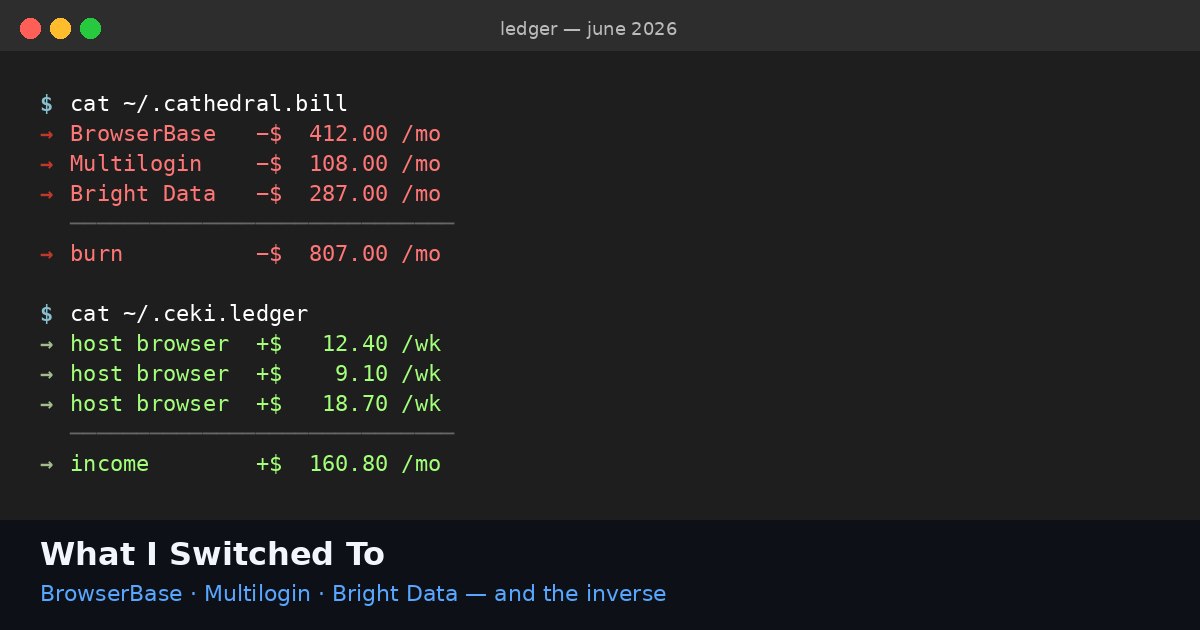
- Cost. Renting a full browser environment (~$5/mo) is more than a cheap proxy. But it's less than the time you'll sink into maintaining a fragile undetected stack.
- SMS verification. No environment solves the "confirm this login with an SMS to a number that only receives in-country" step. That stays with the account owner. Plan around it (e.g., keep the SIM reachable, or use biometric flows where offered).
- Provider trust. You're handing a persistent, logged-in context to a third party. Pick providers like you'd pick a bank: reputation, transparency, API quality, no "too good to be true" greyware. Don't rent your banking session from a Telegram bot you found yesterday.
- ToS gray zone. Operating your own accounts from abroad is generally fine (and very common). Read the service terms; the line is usually about transferring access to third parties and automated circumvention of security measures. Keep your use case to "my accounts, my automation, my region" and you're on the honest side of it.
The takeaway
The browser used to be the thing you scrape with. Now it's increasingly the thing your agents live inside.
Next time you reach for a proxy and a stealth driver, ask: could I instead rent the whole environment — IP, trust roots, profile, automation API — as a single resource? For geo-locked personal services, the second answer is almost always better: less code, less maintenance, more consistency.
And if you're building agents: give your agents a real hand in the physical web. Make the browser rentable. Make it the API.
This is a write-up of a pattern I've been using for my own accounts and automation. No vendor pitch; if you want the practical layer (which provider, what the API surface looks like), that's a follow-up post — comment below if you want it.
What's your stack for operating geo-restricted accounts programmatically? Has the certificate-layer caught you off guard? Let's compare notes in the comments.