I kept reading takes about $5,000-a-month browser bills for AI agents, did the math, and now I want to talk about the part nobody on the agent platforms mentions.
The ballooning line item
Last week someone on my timeline bragged that his company spends five thousand dollars a month on cloud browsers for their agents. Not a joke. Not infrastructure for a team of fifty either - a small operation, a handful of bots, one line item ballooning quietly in the P&L.
I did the arithmetic, and I want to walk through it, because the gap between what these tools charge and what a browser actually costs is the least-discussed margin in the agent stack.
First: what we are actually paying for
Let's be precise about the thing itself. A cloud browser for automation does exactly one job: it gives an agent or a human an isolated browser with a saved session, so logins survive between tasks. That's it.
No GPU. No ML pipeline. No data-center scale. No proxy network. One browser, one instance, one persistent profile. That is the entire product - and it is the entire point.
The price garland
I checked open-market prices before writing this. Here's what the top of the range looks like:
- A well-known browser-infrastructure player: $20/month for 100 hours, $99/month for 500 hours, and $0.10-0.12/hour past the cap.
- Another European player starts around €19-29/month for entry.
- Some tools sell profiles per piece, in packs, with a percentage stacked on top.
And somewhere at the bottom of that garland sits $7/month for a cloud browser with a persistent profile.
Seven dollars. One lunch. Half a latte subscription.
The hidden-hours model
Here's the part that explains the whole difference. Platforms that sell time profit when you run out of it. A hundred-hour cap exists so you overshoot and pay overtime. A result, once delivered, earns them nothing further - so the meter keeps running instead.
The $7 model has no meter at all. The browser is either yours or it isn't. It's yours.
It sounds like a trivial difference. It changes the economics of an entire fleet though.
The fleet math
Take my own scenario. One auto-poster, one platform, one spare account. The agent needs a browser with a saved session so it doesn't log in again every run.
On the old pricing this ran $30-40/month for the privilege of a barely-active browser - because hours burned anyway, and hours run out faster than you expect.
Here: $7, and the profile survives the whole month. It doesn't die when the meter runs out.
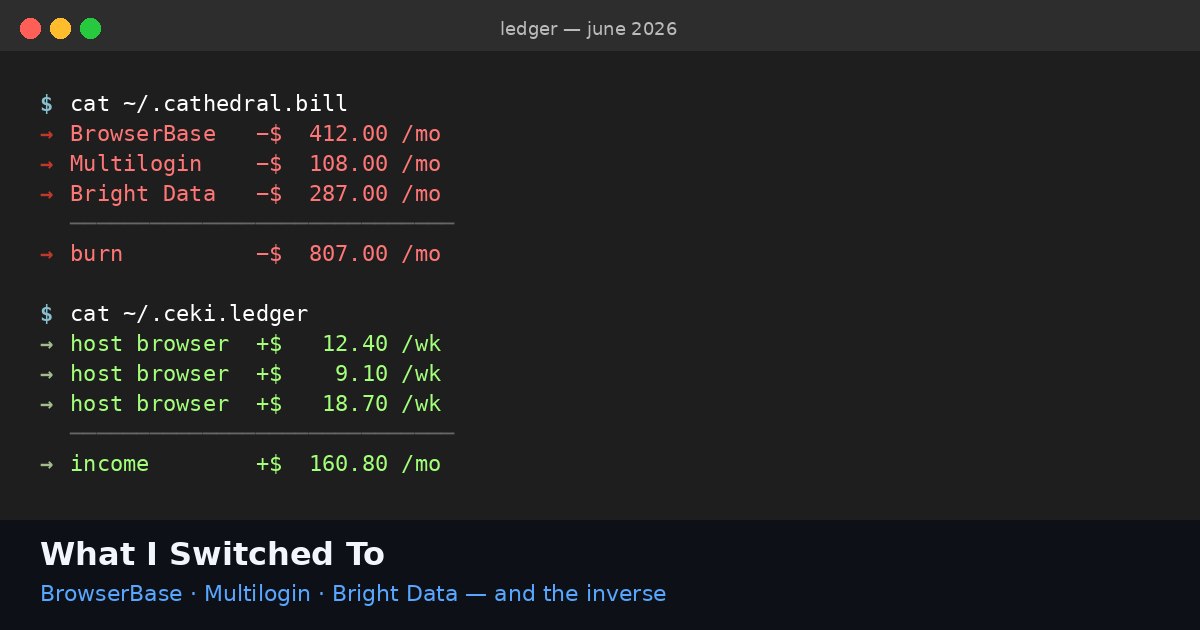
Now multiply. Ten such browsers = a $70 line item. On the old terms, the same ten browsers, if the calculators are honest, pull $400-700/month.
The difference doesn't go to better security or better browsers. It goes to phantom fuel for an hour meter.
The profile is the product
The persistent profile is the core of the entire category. This is the nuance that gets lost in the pricing debate.
In renting a stranger's browser - the marketplace model - the profile dies with the session, because anonymity matters more than continuity. You shell out, you get a clean slate, you're anonymous, and tomorrow it's gone.
In a subscription, the profile is the product. Save a login Monday, come back Thursday, everything is in place. For any operation running agents, that is the difference between:
"The task runs" vs. "The task waits while I re-collect the accesses."
What the agent platform tells you
The agent platforms quietly push the $20-$99 tier because that's where their margin is. The browser is the plumbing - it should be cheap, reliable, boring. The margin belongs further up the stack: in the agent orchestration, the observability, the models.
Instead you see bundled browser fees inflated to make the total look "enterprise." I think that's a mistake. Plumbing should be boring and cheap. You want the exciting, expensive part to be the thing actually making decisions.
Bottom line
Five thousand a month is roughly the price of buying a friend a farm when all you needed was one stall.
A cloud browser with a persistent profile, at market bottom, costs $7 a month. If your agent stack's browser line item is closer to the top of the garland than the bottom, the first optimization isn't a better agent - it's a cheaper room for the agent to live in.
This is one of a series of field notes from running a small swarm of AI agents. Each one tells one real story. No theory, only logs.